Building Flavor in Layers: How Using Different Salts at Every Stage Changes Everything
There's a moment in a really great meal where you pause mid-bite and think, what is happening right now? The food doesn't taste salty exactly — it just tastes more. More complex, more alive, more like whoever made this knew something you didn't.
Chances are, they did. And that something is called salt layering.
It's not a complicated concept, but it does require you to stop thinking of salt as a single ingredient and start treating it like a family of ingredients — each member with its own personality, its own timing, and its own job to do.
Why One Salt Can't Do Everything
Here's the honest truth: a single grain of kosher salt dissolved into a pot of braising liquid and a flake of Maldon finishing salt perched on top of a seared steak are doing completely different things — chemically, texturally, and sensorially.
When salt dissolves into food during cooking, it penetrates cell walls, draws out moisture, and fundamentally changes the molecular structure of whatever you're making. That's deep, foundational seasoning. It builds the backbone of a dish.
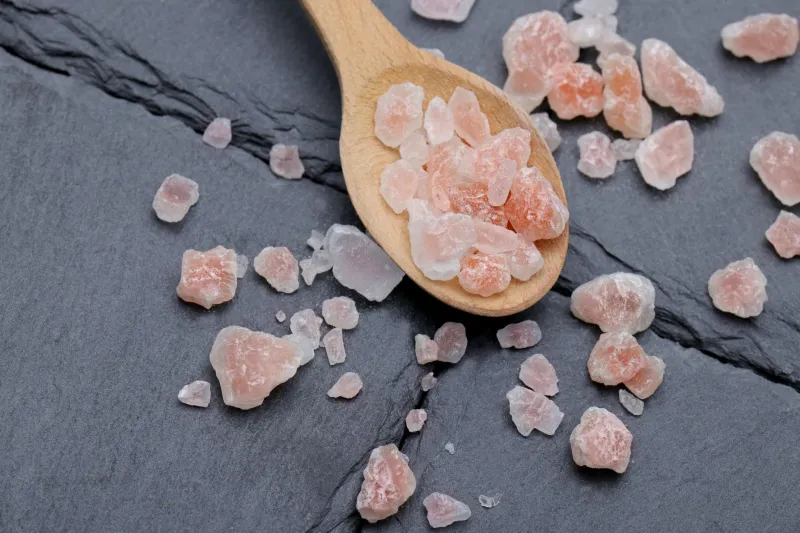
But finishing salt? That's a sensory experience. It hits your tongue first, delivers a sharp burst of salinity, and then fades — leaving behind whatever mineral notes the salt itself carries. Fleur de sel might bring a faint oceanic brininess. A good Himalayan pink salt can carry subtle earthiness. A smoked sea salt adds a whisper of campfire that no amount of cooking technique can replicate.
Those two functions — foundation and finish — are not interchangeable. And between them lies a whole middle ground that most home cooks skip entirely.
The Three-Stage Framework
Think of salt layering in three distinct phases: early, mid, and late. Each stage calls for a different salt and a different intention.
Stage One: The Foundation Salt
This is your workhorse. You want something that dissolves cleanly, distributes evenly, and doesn't bring a ton of its own flavor to the party. Diamond Crystal kosher salt is a classic choice for this stage. It's coarse enough to control, light enough to pinch properly, and dissolves predictably.
You're using this salt to season from the inside out — rubbing it into proteins before they hit the pan, adding it to blanching water, incorporating it into doughs and batters. The goal here isn't flavor impact, it's structural seasoning. You're giving the food a baseline.
Timing matters enormously. Salt a chicken thigh 45 minutes before cooking and the moisture that initially draws out gets reabsorbed into the meat, taking salt with it. That's deeper seasoning than anything you'll achieve in a hot pan.
Stage Two: The Mid-Cook Adjustment
This is where a lot of home cooks check in with a taste and either add more of whatever they started with — or don't adjust at all. But this stage is actually a real opportunity.
If you're building a sauce or a braise, consider swapping in a salt with more mineral complexity for your mid-cook adjustment. A fine grey sea salt (sel gris) brings a slightly briny, mineral edge that integrates beautifully into long-cooked dishes. It doesn't dissolve quite as cleanly as kosher salt, which means it contributes a little more character as it works its way into the food.
For vegetables, this is the stage where you're seasoning sautéed aromatics, adjusting a roasting pan, or finishing a glaze. A small amount of a flavored salt — think garlic-infused sea salt or a citrus finishing salt used before the final plating — can build a flavor note that reads as part of the dish rather than something added on top.
Stage Three: The Finishing Touch
This is the part everyone's heard about but not everyone actually does with intention. Finishing salt is not just about crunch (though the crunch is genuinely great). It's about delivering a specific sensory hit right at the moment of eating.
The key is restraint and specificity. Ask yourself what the dish needs in its final moment. A rich, fatty cut of beef benefits from something with sharp, clean salinity — Maldon flakes or a fleur de sel. A piece of grilled salmon might want something with a smoky finish. A simple roasted cauliflower could be transformed by a pinch of black lava salt, which adds visual drama and a mild, mineral pop.
Apply finishing salt right before the food hits the table — never in the kitchen ten minutes ahead of time. The whole point is that the crystals stay intact long enough to crunch under your teeth.
Putting It Together: A Real Example
Let's walk through a simple seared pork chop using this framework.
Foundation: Season your pork chops generously with kosher salt on both sides about an hour before cooking. Let them sit uncovered in the fridge. This dry-brine technique seasons the meat throughout and helps develop a better crust.
Mid-cook: After searing and while basting with butter and herbs, add a small pinch of sel gris to the pan. It'll incorporate into the butter baste and add a subtle mineral depth to the crust.
Finishing: Rest the chop, slice it, and before it goes to the plate, hit it with two or three flakes of a smoked sea salt. The smoke echoes the char from the sear and gives the dish a final aromatic complexity that makes it taste like you spent way more time on it than you did.
The total amount of salt used isn't dramatically different from what you'd use with a single-salt approach. But the experience of eating it? Completely different.
The Mineral Dimension
One thing worth understanding is that different salts carry genuinely different mineral profiles — trace amounts of magnesium, calcium, potassium, and other minerals that got left behind when the salt wasn't refined to pure sodium chloride. These aren't just marketing talking points. They actually affect flavor perception.
Magnesium, for instance, contributes a slight bitterness that can balance richness. Calcium adds a subtle sweetness. These are small effects, but stacked across multiple salts used at multiple stages, they add up to something your palate registers as depth even if your brain can't fully explain why.
This is why a dish seasoned with one refined salt can taste flat compared to one built with two or three specialty salts — even if the total sodium content is identical.
Start Simple, Go From There
You don't need a pantry full of exotic salts to start experimenting with this technique. Three salts will get you surprisingly far: a good kosher salt for foundations, a grey sea salt or fine sea salt for mid-cook adjustments, and one quality finishing salt for the final touch.
Once you've cooked through a few dishes with that basic three-salt rotation, you'll start to develop an intuition for where different salts belong — and that's when things get genuinely fun. You'll find yourself reaching for a Hawaiian red alaea salt when a dish needs warmth, or pulling out a citrus-infused flake when something needs brightness without acid.
Salt layering isn't a restaurant technique that doesn't translate to home cooking. It's actually one of the most accessible ways to immediately elevate what you're already making. You just have to stop thinking of salt as a single ingredient — and start thinking of it as a whole pantry of possibilities.